Note: This story from the Boston Globe's website and hard copy paper.
See also "Noble & Cooley To Re-Issue Civil War Drums to Commemorate War's 150th Anniversary in 2011," this blog, Sep. 1, 2010.
-----
Drum maker draws on its past for better future
Replica snares help Granville firm endure
By James Sullivan
Globe Correspondent / June 29, 2011 (Business Section, p. B5)
© Copyright 2011 Globe Newspaper Company.
GRANVILLE — They are still managing to keep time at Noble & Cooley, a Civil War-era drum company in Western Massachusetts.
After decades as one of the country’s biggest suppliers of toy drums, Noble & Cooley in the 1980s branched out to make state-of-the-art drum kits, with customers that included Phil Collins and Paul McCartney. But the bleak holiday shopping season that followed the Sept. 11, 2001, terrorist attacks nearly led to the company’s demise. As during other trying times in its history, Noble & Cooley somehow persevered, even as it got smaller.
Today, the company is trying to remain relevant by capitalizing on its rich heritage. To commemorate the 150th anniversary of the start of the Civil War, Noble & Cooley is producing replicas of the snare drums Union soldiers used to communicate on the battlefield. It is also one of 100 finalists in the This Place Matters grant challenge, sponsored by the National Trust for Historic Preservation. Online voting closes tomorrow, with the top vote-getter receiving $25,000.
“We’re doing everything we can to hang on,’’ said Jay Jones, the company president. He is a sixth-generation descendant of cofounder James P. Cooley, who began making drums in Silas Noble’s kitchen in 1854.
Once a holiday season powerhouse, with a peak of 120 employees two decades ago, Noble & Cooley is now a true mom-and-pop shop. There are just three full-time workers: Jones; his wife, Carol; and their 27-year-old son, Nick.
When he first joined his father in the family business, Jones, 57, shifted some of the emphasis away from the toys that had been a staple for years. Thanks to the rich tone of its natural wood drums (most contemporary drums, including some of Noble & Cooley’s, are plywood), the company quickly attracted a loyal customer base among some of the world’s top musicians.
Collins once appeared in an endorsement advertisement alongside an image of Abe Lincoln. Noble & Cooley’s cofounders made a presidential campaign drum for Lincoln in 1860, using wood that he had chopped years before.
Jonathan Mover, an acclaimed drummer and the editor in chief of Drumhead magazine, found out about Noble & Cooley drums from musician Chris Whitten, who used to play with McCartney. Mover bought two limited-edition snares years ago.
“They’re absolutely two of the finest snares I have,’’ said Mover, a Peabody native who also runs Skyline Recording in New York. “And I have got a serious collection, over a hundred.’’
Mover credits Noble & Cooley’s commitment to quality as an inspiration for larger drum companies, such as Yamaha, Pearl, and Tama.
“All the big companies are making very high-end gear, which they really didn’t do years ago,’’ he said. Unfortunately, Mover said, that has created considerable competition for a small, family business such as Noble & Cooley.
The company still builds several dozen custom drum kits (some of which sell for up to $10,000) and as many as 500 solid-wood snares each year. Although it’s not the first time the drum company has faced adversity.
History of Noble & Cooley
Few episodes, however, were as devastating as the economic plunge that followed Sept. 11, 2001. That downturn effectively wrecked the company’s toy business, which had reached a peak of $3 million in annual sales in the late 1970s. Noble & Cooley was left holding two dozen containers of unsold toy instruments imported from China when some of its biggest clients, including Sears and JC Penney, canceled holiday orders.
“The bank started running scared,’’ said Jones. “They called in the note. It took me six years to pay off’’ the bank. To do so, he had to sell off hundreds of acres of family property in this rolling farmland west of Springfield.
The Noble & Cooley compound — three big old buildings with tilting floors, connected on the upper levels by iron pedestrian bridges — is a much quieter place today than it was at the height of toy production. In fact, one building isn’t even used.
Walking around the factory on a recent Friday, Jones was called away to help unload machine parts from a delivery truck. As a light drizzle fell outside the loading dock, the driver looked around the barn-like warehouse, which was mostly empty.
“I totally forgot this place was here,’’ he said.
A cardboard pallet box sat off to one side, full of tin tambourines featuring characters from Jim Henson’s old “Fraggle Rock’’ series. Their plastic sleeves had long since grown moldy.
Nick Jones helped his father empty the truck. He plays bass in a metal band with his older brother, Jonathan. Jonathan, a graphic designer with waist-length dreadlocks, is the real drummer in the family, said Jay Jones.
“I play the radio,’’ he joked.
When they were kids, Nick and Jonathan had the run of the place.
“It was awesome,’’ said Nick. “There were tons of cardboard boxes to play in. We played with tin scraps. We were obnoxious.’’
Now, the boy who once terrorized seasonal employees actually does have the run of the place. Reduced to such a tiny operation, these days it takes the company eight to 10 weeks to fill a custom drum order. The process to make a Civil War replica snare — steaming, bending, aging, and curing — requires 16 weeks.
Jay Jones and his son assemble each reproduction drum, made of steam-bent tulipwood, using the same heavy, belt-driven machinery that employees operated more than a century ago.
Noble & Cooley took one of the drums, which are numbered, to the most recent Gettysburg Remembrance Day event last fall. “People were throwing credit cards at us to get a low serial number,’’ said Jones.
Having retrenched, the family knows that the value of its product is directly related to the time and care they put into it.
Jones, smiling, credited a friend with his new philosophy.
“There’s no such thing as a drum emergency,’’ he said.
Photo Credit: Matthew Cavanaugh for The Boston Globe
This year marks the 150th anniversary of the Civil War. To commemorate the occasion, Noble & Cooley, a drum company in Granville, will be producing replicas of the snare drums that Union soldiers played on the battlefield as a form of communication.
The small, family-owned company goes back even further than this moment in history, back to 1854, and is still pounding away at business. Click through the slides to see a behind-the-scenes look at the factory and a peek into its history.
Photo Credit: Matthew Cavanaugh for The Boston Globe
Jay Jones, 57, pictured here, is the president of Noble & Cooley and a sixth generation drum maker, a direct descendant of the company's founder, James P. Cooley. Despite struggling through fires, the Great Depression, World War II, and the holiday season following 9/11, all of which have put the company at risk, it still continues to make drums of all kinds, such as replicated snare drums, and even at one point made drum kits for some of the world's top musicians.
Photo Credit: Matthew Cavanaugh for The Boston Globe
The company turned to making state-of-the-art drum kits in the 1980s. Capitalizing on the rich tone of natural wood drums, the company quickly attracted a loyal customer base that included Phil Collins and Paul McCartney.
Jonathan Mover, an acclaimed drummer and the editor-in-chief of Drumhead magazine, credits Noble & Cooley’s commitment to quality as an inspiration for the larger drum companies, such as Yamaha, Pearl and Tama.
“They’re absolutely two of the finest snares I have,” said Mover.
Photo Credit: Matthew Cavanaugh for The Boston Globe
The company peaked in the late 1970s with a top annual revenue of $3 million. At one point, it had 120 seasonal employees. However, there was a downturn after Noble & Cooley was left holding two dozen containers of unsold toy instruments imported from China when some of its biggest retailers essentially canceled Christmas following the 9/11 attack.
“The bank started running scared,” says Jones. He had to sell off hundreds of acres of family property to pay back the banks.
Pictured: old products on display in the museum.
Photo Credit: Matthew Cavanaugh for The Boston Globe
All of the drums are handmade, crafted by one of the company's three employees: Jones, his wife Carol, and their son Nick Jones, 27. They make use of heavy, belt-driven machinery, much of which was in use over a century ago. Each drum is made of steam-bent tulipwood. Here, a red oak shell for a snare drum is lathed.
Photo Credit: Matthew Cavanaugh for The Boston Globe
In addition to filling orders, the company also doubles as a museum. The Society of Industrial Archeology visited the old factory, took a look at the old machinery, and recommended preservation. Now Noble & Cooley is one of 100 finalists in a grant challenge sponsored by the National Trust for Historic Preservation called This Place Matters. Online voting closes on June 30. The top vote-getter will receive $25,000.
Photo Credit: Matthew Cavanaugh for The Boston Globe
Here, Nick Jones sands a red oak shell for a drum. He is a musician too. He plays the bass in a band with older brother Jonathan, who is the real family drummer.
-----
Notable Products in the 157-year history of Noble & Cooley:
- A presidential campaign drum in 1860 for Abraham Lincoln, using wood Lincoln had chopped years before.
- Giftware in the '60s and early '70s that included waste baskets, ice buckets, lamps and cutting boards.
- Toy drums for retailers such as Sears and JC Penney
- State-of-the-art custom drum kits for Phil Collins and a drummer for Paul McCartney's band.
- Replicas of the snare drums used by Union Soldiers on Civil War battlefields to convey messages.
Employees:
1854: 2
Founders Silas Noble and James P. Cooley.
1980s: 120
2011: 3
Jay Jones, a descendant of Cooley, his wife Carol, and son Nicholas.
“Build it and they will drum.” Dedicated to research, study and comparisons of field drums. Our purpose is to collect information about historical U.S. drums (manufacture, preservation, conservancy, repair, market) for use by scholars, collectors and others. Photographs of drums, and anything related, together with informative narratives, are welcome. Interested readers will find archived postings a good resource. Reach us at emirsky@gmail.com.
Showing posts sorted by relevance for query noble cooley. Sort by date Show all posts
Monday, July 4, 2011
Wednesday, September 1, 2010
When It Comes to Faux
Faux (pronounced /ˈfoʊ/, like "foe") is a French word for false or fake. And that's what this is.
eBay seller maxwellstuxedo ( 1236) just sold item no. 290468616826 for $113.49 and it's about as faux as they come. Not that it's any kind of fraud. The faux nature was fully disclosed. It's a faux drum built by Noble & Cooley and sold under the "Old Drum Shop, Granville, Massachusetts" label. (I confirmed the relationship between Old Drum Shop and Noble & Cooley today in a telephone conversation with Jay Jones, president of Noble & Cooley). The item is described as "antique furniture" (well, maybe not really antique, but, well, faux antique). Old Drum Shop drum-like tables and other drum-like items (waste paper baskets, ice buckets, etc.) are readily found on the Internet and can be ordered directly from Noble & Cooley in Granville, Massachusetts.
Ordinarily we wouldn't mention this kind of item in this blog except that here we think that there might be a danger of confusion with the real thing (i.e., a real Civil War drum, which this item certainly is not nor is it intended to be). In this case the table looks surprising close to the real deal, at least in the photos.
The Old Drum Shop, Granville, Massachusetts
Photo: eBay item no. 400083174207 (postcard)
The Old Drum Shop is the name of the retail store on premises at Noble & Cooley's manufacturing plant in Granville, Massachusetts. It appears to have derived from the drum factory started by Silas Noble and James P. Cooley in 1854. (Jay Jones, with whom I spoke today, is the great-great-great grandson of James P. Cooley.)
The drum-like table is described as follows:
A wood drum table made in the 1950s-60s to look like a civil war drum. It has a great look and has some nice details like the rope and the leather straps. The top of this has some faux marble contact paper that actually looks good. You could just peel it off and has just the wood underneath with a bit of cleaning. It is very heavy, well made, and sturdy. It measures 25 inches tall and 20 inches wide.
For more information on Noble & Cooley, please see:
Field Drums: Noble & Cooley Center for Historic Preservation, this blog, August 4, 2009.
Field Drums: Scoping a Civil War Artifact, this blog, October 20, 2009.
Field Drums: Nobel & Cooley Civil War Drum, this blog, December 23, 2008.
Field Drums: Civil War Eagle Bass Drum (attrib. 7th Wisconsin Iron Brigade), this blog, May 31, 2008.
eBay seller maxwellstuxedo ( 1236) just sold item no. 290468616826 for $113.49 and it's about as faux as they come. Not that it's any kind of fraud. The faux nature was fully disclosed. It's a faux drum built by Noble & Cooley and sold under the "Old Drum Shop, Granville, Massachusetts" label. (I confirmed the relationship between Old Drum Shop and Noble & Cooley today in a telephone conversation with Jay Jones, president of Noble & Cooley). The item is described as "antique furniture" (well, maybe not really antique, but, well, faux antique). Old Drum Shop drum-like tables and other drum-like items (waste paper baskets, ice buckets, etc.) are readily found on the Internet and can be ordered directly from Noble & Cooley in Granville, Massachusetts.
Ordinarily we wouldn't mention this kind of item in this blog except that here we think that there might be a danger of confusion with the real thing (i.e., a real Civil War drum, which this item certainly is not nor is it intended to be). In this case the table looks surprising close to the real deal, at least in the photos.
Photo: eBay item no. 400083174207 (postcard)
The Old Drum Shop is the name of the retail store on premises at Noble & Cooley's manufacturing plant in Granville, Massachusetts. It appears to have derived from the drum factory started by Silas Noble and James P. Cooley in 1854. (Jay Jones, with whom I spoke today, is the great-great-great grandson of James P. Cooley.)
The drum-like table is described as follows:
A wood drum table made in the 1950s-60s to look like a civil war drum. It has a great look and has some nice details like the rope and the leather straps. The top of this has some faux marble contact paper that actually looks good. You could just peel it off and has just the wood underneath with a bit of cleaning. It is very heavy, well made, and sturdy. It measures 25 inches tall and 20 inches wide.
For more information on Noble & Cooley, please see:
Field Drums: Noble & Cooley Center for Historic Preservation, this blog, August 4, 2009.
Field Drums: Scoping a Civil War Artifact, this blog, October 20, 2009.
Field Drums: Nobel & Cooley Civil War Drum, this blog, December 23, 2008.
Field Drums: Civil War Eagle Bass Drum (attrib. 7th Wisconsin Iron Brigade), this blog, May 31, 2008.
Tuesday, December 23, 2008
Nobel & Cooley Printed Label
The Noble & Cooley Center for Historic Preservation
Dedicated to Celebrating Yankee Ingenuity
Tucked away in the foothills of the Berkshires is an intact factory with all the machinery necessary to manufacture toy and professional drums. SIA toured the factory during the 1988 Connecticut Valley Tour. The Southern New England Chapter visited the site for an in-depth inspection of the Company's manufacturing equipment in 2005.
In 1854 Noble & Cooley Company, located in Granville Massachusetts, began manufacturing drums. The area has a unique heritage in small-scale industry and in particular in producing vernacular solutions to technological problems. The local farmers, faced with diminishing returns in agriculture and shortages of labor, turned to mechanized manufacturing to survive.
Noble & Cooley is a surviving example of the manufacturing firms that were once plentiful in the remote valleys of New England. Silas Noble, a master mechanic, and James P. Cooley, an entrepreneur, started by making drums in Noble's farmhouse kitchen. The drums sold quickly and in 1856 they built their first factory. Business expanded during the Civil War when the Company produced drums for Northern regiments. During this period the factory expanded and the company switched over from waterpower to steam. By 1873 they were producing 100,000 drums a year. Around this time vernacular tooling, jigs and fixtures were introduced to cut labor costs and increase output. The Company developed proprietary technology in steam bending, decorating and assembly of drums.
At the turn of the 19 th century Noble & Cooley adapted the technology for manufacturing "tin" cans to making toy drums. A machine for printing up to eight colors sequentially was developed and built in the machine shop. Toy drums continued to sell and the company adapted to WWII materials restrictions by building paperboard drums. Mid-20 th century marketing strategies included licensing of Disney and Muppets characters to be printed on the drums to increase sales.
In recent years globalization and a changing market in children's playthings have eliminated the economic viability of large scale toy drum manufacturing. For the past 20 plus years the company has shifted focus to the manufacturing of very high quality professional snare drums and drumsets. The machinery and production space used to manufacture toy drums has been unused. The owners, descendants of the founders, believed that the Company was historically significant and should be preserved. They generously agreed to transfer ownership of some of the historic buildings and machinery to a non-profit organization with the objective of preserving the Company's history and manufacturing technology.
Local preservationists organized The Noble & Cooley Center for Historical Preservation (NCCHP), a 501 (c)3 non-profit corporation. The mission of the center is to preserve the regional history of manufacturing, agricultural pursuits, and rural crafts through acquisition and maintenance of significant historical buildings, machinery, historical collections and local artifacts. Initially, the focus will be on dynamic demonstrations of manufacturing toy drums. The corporation will also promote preservation and study of the acquired properties, collections, and artifacts and make them available to the public. The museum will be located within the historic buildings of Noble & Cooley Company on Water Street in Granville, Massachusetts.
The historical buildings will provide the space in which to build an educational facility to share the history of the region. The factory buildings retain much of the equipment that was used to manufacture toys from the 1850's through the 1950's. The museum will also preserve and demonstrate the progression of factory power sources from water to steam to electricity. The rural character of western Massachusetts will be represented in displays of farming and logging techniques of the 19 th century. The center will be a showcase of the "Yankee Ingenuity" that enabled the local area to prosper.
Tuesday, September 7, 2010
Noble & Cooley To Re-Issue Civil War Drums to Commemorate War's 150th Anniversary in 2011
(leather tugs will be stained dark on the reissued line)
This drum is currently on exhibit at the Drummer Boys, "Answering the Call" exhibit, Zadock Pratt Museum, Prattsville, New York.
(See article below re the Drummer Boys exhibit.
Using 1860 Wood Bending Machine to Bend Tulip Wood Shells
Photos and above information courtesy of John C. Quinn, Civil War Collector, Historian and Musician, Windham, New York (JCQuinn@webtv.net)
Granville, Massachusetts - Jay Jones, president of Noble & Cooley and great-great-great grandson of one of its founders, James P. Cooley, said that the company plans to reissue its Civil War contract field snare drum conforming to period specifications using the same, gigs, fixtures and forms used during the Civil War. Noble & Cooley would be the only company to ever do so. Jones declined to discuss the price point but it is expected to be competitive.
This will not be a reproduction Civil War drum but something completely different. It will be the same drum, made to the same specifications, using the same material and made in the same factory using the same machines as when this line of drums was originally manufactured for the U.S. Army.
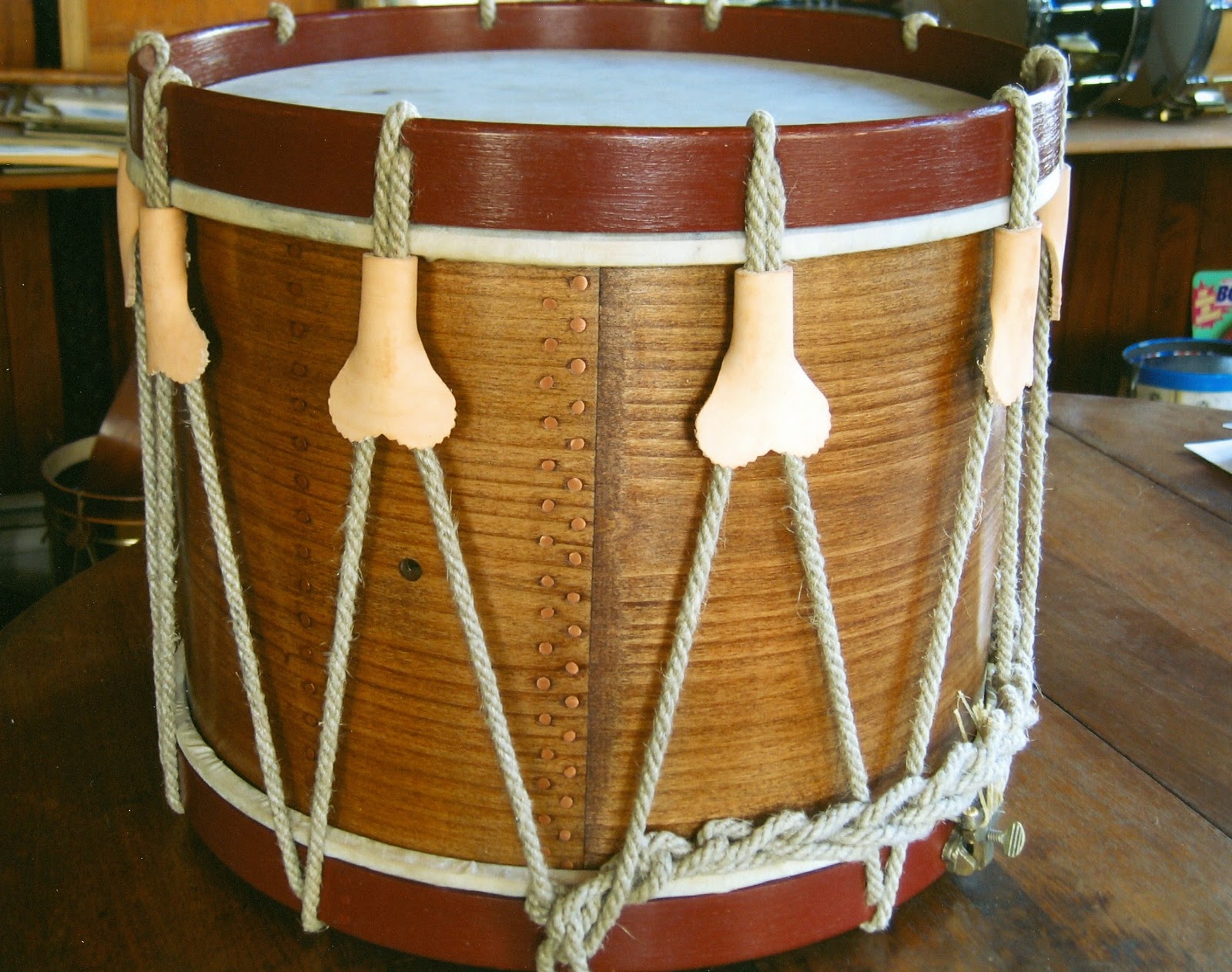
The reissued drum will measure 12"x16" (16-3/4" to the outside of the counterhoops) with red-painted oak counterhoops mounted on a single-ply tulip shell. The snare mechanism will be the same bronze/brass design used by Noble & Cooley for its Civil War contract drums, including a leather butt plate securing 8 gut snares. The drums are planned to be unpainted, but stained walnut and coated with shellac. The seams will be secured by copper tacks as were the first issues of this line. The drums will be equipped with calf skin heads and a rope loop for carrying (pre-D-ring).
The ropes will be Irish linen although Jones recalled his grandfather telling him that the originals used 7-strand Italian hemp which the company is currently having difficulty locating. (From 1937 until the late 1960s the United States government recognized that industrial hemp and marijuana were two distinct varieties of the cannabis plant. After the Controlled Substances Act (CSA), hemp was no longer recognized as being distinct from marijuana. That may account for the difficulty in securing hemp. History of Hemp. See also, Hemp, THE ENCLCLOPAEDIA BRITANNICA, 1856: "The Italian hemp is very fine, that variety called garden-hemp being the longest of any kind; its superiority is supposed to be the result of spade culture in very suitable soil. It is also as white and soft as the finest white Russian.")
A prototype of the re-issued line is already in the field and in use by the 77th New York Regimental Balladeers of Windham, New York, a Civil War reenactor singing group. The drum is being used in connection with efforts to raise funds for a special celebratory Historic Heritage event featuring musical performers at the Noble & Cooley Center for Historic Preservation.
Separately, John Quinn, spokesperson for the Balladeers, who is working with Noble & Cooley to produce the event, mentioned that production of 50 sesquicentennial drums is underway in Granville. He also confirmed that the prototype drum can be seen sitting on the stage in the video below. Quinn said that the prototype is currently on exhibit at the Zadock Pratt Museum in Prattsville, New York and that the drum will go on tour with the Balladeers beginning with the group's September 18 appearance at the Saratoga Springs Civil War Encampment at Congress Park, Saratoga Springs, New York. The drum will be raffled off by the Balladeers who, while on tour, are raising funds for the Historic Heritage event in Granville.
Monday, July 4, 2011
Noble & Cooley's Civil War Snare
In 1854, in the rural town of Granville Massachusetts, Silas Noble and James P Cooley set about the business of making toy drums. The company flourished and in a short time they were making thousands of drums a year. The call to war in 1861 shifted the production from toy drums to military snare and bass drums.
One hundred and fifty seven years later, the descendants of James Cooley are still in the business of making drums at Noble & Cooley Company in Granville. From millions of toy drums to production of high end steam-bent snare drums and custom drumsets, this little company has continued to make drums since 1854.
A few years ago the company decided to turn some of its factory space into a museum with a focus on “Yankee Ingenuity” and industrialism in rural New England. While gathering and assembling artifacts, they were approached by a Civil War memorabilia broker who was in possession of a drum made by the company and picked up off the battlefield at Gettysburg. The museum reached out to the community for support and was able to bring the drum home to Granville where it is prominently displayed along with its provenance.
This spurred interest in the role Noble & Cooley and the town of Granville played in the war efforts and also caused the owners and family to dig further into the archives. Jigs and tooling were found. A local logger was called in to identify the wood on the returned drum. Family diaries were read and re-read. And the decision was made that six generations later, the Noble & Cooley Drum Company would once again make a contract Civil War Drum to commemorate the Sesquicentennial in 2011.
The “contract drum” was the standard issue drum ordered for the Union Army. It was a single ply, steam-bent shell of either tulip wood or ash with oak hoops and calfskin heads. The reissue drum is 12” deep and 16” in diameter. The shell is of tulip wood from trees cut within a few miles of the factory. The wood is steam bent using the same steam chest and methods used 150 years ago.
Noble & Cooley plans to produce a limited number of this commemorative drum from 2011-2014. The drums will be sequentially numbered and will be shipped with a “certificate of authenticity” which will include a brief history of the company and the specifics of the drum.
Tuesday, October 20, 2009
Scoping a Civil War Artifact
Quality Magazine
January 2, 2008
When Jay and Carol Jones of Granville, MA-based Noble & Cooley Drum Co. learned that one of the firm’s Civil War-era military drums had surfaced, they wanted a closer look. So they called Instrument Technology Inc. (ITI) of Westfield, MA.
“We knew that drummer boys who went into battle often opened their drums and inscribed their name, the date and the date and place where they saw action,” says Jay Jones, current company president and great-great-great grandson of James Cooley, who, along with Silas Noble, founded the drum manufacturing company in 1854. “When my wife received a call from a Civil War antiques broker saying he’d heard at a trade show that he had a Noble & Cooley drum with a supposed history of having been used at the Battle of Gettysburg, naturally, we were intrigued.”
The drum arrived at their facilities with even the side ropes and leather ears in tact. Because the drum is so old, they did not want to damage it by removing the skin heads in order to look inside. The single piece of steam-bent wood that forms the drum barrel was inaccessible, except through a 5/8-inch diameter hole in the wood designed to let air escape when the drum is played.
An area commercial photographer, James Langone, happened to be doing work for Noble & Cooley at the time. He also had worked with ITI.
“When Jim told me about the capabilities of ITI scopes, I knew right away what he meant,” Jones says. As a mechanic, Jones has used a borescope. “If there was a scope that could help us look inside the drum, I wanted to give it a try.”
The scope for the job was ITI’s V5 Videoscope.
Says Jeff Briers of ITI, “We knew a videoscope would offer the crisp, detailed images they needed. Their request was different from most of our customers, but we knew we had the right scope for the job.”
Stationary photos of the interior were viewed on the compatible screen. The images clearly showed a label, which, though a bit torn in a couple of places, was from Noble & Cooley. It matched one of the original labels saved in the company’s archives that depicts the company as “Manufacturers of Military and Toy Drums.”
“Our records indicate that many of the drums we made in the Civil War era were used by the Massachusetts Volunteer Infantry 10th Regiment,” says Jones. The owner of this drum was in the hands of James Forrest of the 28th Pennsylvania Mil, Infantry Company F. He went on to serve in the 187th Infantry and the 131st all of Pennsylvania. The soldiers also were present at Yorktown, Fredricksburg, Salem Heights and many other active fighting locations.
Unfortunately, there were no writings inside the drum to confirm the connection to any of the battles. The only writing was a number, “No. 8,” which denotes the drum size. “We were a little disappointed,” Jones says. “But treasure hunts don’t always turn out the way people hope.” They did, however, see a knitting needle, a pencil and a small stick at the bottom of the drum. “Maybe we weren’t the first ones to want a look inside,” he adds.
The intrigue won’t stop with this drum. The company is trying to locate the Lincoln drum, a special drum that was made for Abraham Lincoln’s presidential campaign. Crafted with silk cord and sterling silver ears, the piece was noted in James Cooley’s diary: “Finished the Lincoln drum today,” he wrote. “It is the finest one ever made.” The company believes this drum was used by the Massachusetts Volunteer 10th Regiment. At this time they are following up with a few leads, but are not sure where it is and if they will ever find it.
Instrument Technology Inc. (ITI)
413-562-3606
www.scopes.com
Source of Graphic Image: Young folks' history of the Civil War By Clara Emma Cheney
Saturday, May 31, 2008
12th Indiana Infantry Civil War Drum
In January of 1854, Silas Noble and James P. Cooley started making Drums in the Noble farmhouse kitchen. Their drum was an immediate success. In a few weeks they moved into a small building and after two years built their first factory.
In 1860 Noble & Cooley Co. made a Drum of a rail split by Abraham Lincoln which was used in political rallies in Massachusetts and Connecticut. This Drum was presented to the 10th Massachusetts Regiment and finally found a resting place in the United States Patent Office.
During the Civil War the Company boomed making Drums for the Northern Regiments. At this time, many changes occurred with expansion to a larger factory and change from Water Power to Steam Engine, all influencing the continued growth of the Company.
A few years later they made the Largest Drum on record, it being Eight Feet in Diameter. This Drum was made especially for use in Boston in 1869 at Gilmore's National Peace Jubilee, and later used in the 1876 Centennial.
Noble & Cooley Co. made not only Military Drums of all sizes, but also Toy Drums. In 1854, the Company produced 631 Drums; by 1873 they were manufacturing 100,000 Drums a year! Special machinery was designed and built to aid in the difficult process of Steam Bending, Decorating and Fabricating the Drum parts. Many of these machines have been restored for use on this line of reproductions.
Granville, our home, is a typical small New England Village in the foothills of the Berkshires. The business is still owned and operated by the descendants of James P. Cooley and retains the original firm name. Through the years, improvements in buildings and manufacturing processes have been made, but the company has retained much of its antiquity and charm.
Information from Cowan's Auctions Website:
Price Realized Including Buyer's Premium: $2,875.00
Auction: 2002 Americana & Decorative Arts. November 20.
254. CIVIL WAR SNARE DRUM FROM THE 12TH INDIANA INFANTRY, presented to Alfred Barker, on May 5, 1861. A 16" snare drum, manufactured by Noble and Cooley, East Granville, Mass. Body painted red, with a well-executed American eagle on the side with a banner its beak with portions of Barker's name and "snare drummer" visible. The head bands black, over an original red wash.
The perimeter of the bottom head is pricked and painted with the following inscription, portions of which are unreadable becuase of a large split: "Presented to A.L. Barker by Capt___ Camp Sullivan May 5th, 1861." In the center of the head is: "Capt___ O'Brien." Barker was the drummer for Co. D, of the 12th Indiana. He mustered into service on May 14, served a one year term, and was out on May 19, 1862. Barker was present at Williamsport and Sharpsburg, Maryland, the advance on Winchester, Virginia, participated in a skirmish at Stephenson's Station, the Shenandoah Valley campaign, and a skirmish at Rappahannock Crossing.
This drum was presented by Barker by Captain William O'Brien of Company D. O'Brien mustered out with Barker, and then re-enlisted, serving as Lt. Colonel of the 75th Indiana. The drum is accompanied by a 1958 newspaper clipping from the Chicago Tribune in which it, and several other Civil War relics are illustrated.
According to the article, it was part of a collection assembled by Brigadier Charles S. Bently, an Iowan. His collection was sold in 1922 to two Chicagoans, Mrs. Denise Henredeen and Agnes See. The collection was exhibited at the Century of Progress Exhibition in Chicago and 1934 and then was placed in storage, where it remained until the time of its sale in 1958.
The eagle darkened from an original layer of varnish, and suffering from paint loss in its face, and the banner. Minor paint loss elsewhere. Bottom head split, with some loss. The painting well-worth cleaning and restoring.
(EST $2500-$3500)
Price includes buyer's premium.
Cowan's Auctions, Inc.
6270 Este Ave
Cincinnati, OH United States 45232
513-871-1670
Thursday, November 11, 2010
Restoration of a Mid-19th Century Field Snare Drum
I received this article today from Randolph ("Randy") Davis, a drummer and drum refurbisher. Compare some features of Randy's drum with those on my "Drum by John Lowell," this blog, March 5, 2008.
My New Player
2011/11/10
Article Contributed by Randolph Davis
Baltimore, MD
Friends,
Having just now tied off the drag rope, I’d like to share my newest toy which I bought at the Baltimore Gun Show last year (2009). There I found a cracked shell and counterhoops form a mid-19th century drum, and some old heads sans flesh hoops artfully displayed across the open ends of the shell. The shell had a crazed unidentified surface finish, and all-in-all, it looked like hell. I decided I wanted it, so my friend, Jim Kochan, lent me the cash to buy it. I recall it costing $250.00 (after a $50 talk-down). It is now sturdy player of which I am very proud.
I gave the shell a quick surface clean with a damp cloth and found several cracks spanning the length of the shell along the grain, one spanning the entire length of the shell. That was bad news for a drum that I wished to transform into a player.
I bought some 1/8” white oak strips, soaked them in water for about ½ hour, bent them around the shell to dry, and then I glued them across the cracks on the inside of the shell using Old Brown Glue. That stuff is a truly amazing organic hide glue with urea added to lengthen the working time. A simple warming makes the glue workable for several hours. This stuff is heaven, and I can recommend it without hesitation. I also used it to reglue the shell support hoops and loosening scarf joints on the counterhoops. It worked to great effect and, as advertised, simply bonded with the old glue. Other than a little spotting from the iron traces in Baltimore tap water reacting with the tannic acid in the oak (which I was able to correct with oxalic acid), there were no real issues.
Next I scraped the surface finish off using a water-based varnish remover which worked well after two applications. I used a flexible plastic putty knife because I wanted to retain the planer marks on the outer shell. I gave the shell a denatured alcohol bath and it cleaned nicely. I first attempted to shellac the drum, but I felt that this would not be a sufficiently sturdy finish for an outdoor drum. (I have since learned that the Noble Cooley 150th anniversary drums are using shellac and apparently this is the historic finish for Noble Cooley drums.) So I removed the shellac and hand rubbed the shell (first with my bare hands and then with the grain, using 0000 steel wool) using a 50/50 refined linseed oil/turpentine finish. I applied about seven coats which did a nice job to create a slurry to fill the cracks and other imperfections. I used Gamblin refined linseed oil which is said to use a refining process that is 150 years old. The final touch was wheat pasting a hand-made label inked by my good friend Fred Rickard.
With the shell and counterhoops complete, I ordered rope, heads, snares, strainer, and custom cut and bent flesh hoop blanks from Cooperman Drum Company. I sized flesh hoops to the shell, and glued them using the same Old Brown Glue. I nailed them with carpet tacks based on contextual examples in my own collection. I tucked the heads and dyed the rope overnight in a batch of strong English breakfast tea (Cooperman sells a sort of bleached linen rope.) The Cooperman linen rope is four strands, as is typical for drum rope on American drums of the period. Unfortunately, it is not spun as tightly as other original rope I have seen, and I wanted “drum rope”. I have heard other drummers speak favorably of hemp linen rope available in Eastern European markets, but I don’t know of any four-strand rope of this type, and I felt that the tea-dyed linen rope was the right decision for this restoration.
I made the ears, copying an original example on another drum in my collection. I used an antique pinking iron to punch the ends, and seven-cord hand waxed linen thread to tie the ears.
I mounted the Cooperman reproduction Civil War style strainer. But after roping the drum together, it occurred to me that this design would not work, for the rope hole was too close to the strainer side snare gate. There was no room for the upright thumbscrew to function. This posed a problem that might have prevented the result I wanted. But not so! I inquired with Noble and Cooley, who is embarking on a reproduction drum project in celebration of the 150th anniversary of the war, concurrently with contacting the one and only George Carroll of Carroll’s Drum Service. George gave me a different but common style (of which I have a couple on drums in my collection) counterhoop-mounted hinge-style strainer, which works excellently in the above mentioned situation. His casting apparently comes directly from an original dug at Brandy Station battlefield. I came to find out that Noble and Cooley is using the same strainer supplied by George for their restorations.
So I soaked and mounted the snares, and plugged a few small holes in the counterhoops where previous appliances had been mounted (a carry on the batter counterhoop, and previous strainers on the snare side). That was an afterthought, but something I could do without dismantling the drum.
And just a listing of my friends who helped me along the way: my wife for dealing with insanity on a regular basis; George Carroll for keeping this fife and drum business alive south of the Mason Dixon, and reproducing this strainer; Jim Ellis at Cooperman, who is the embodiment of kindness and sage; George Hardy for his magical tea-dying recipe; Jim Kochan for spotting me the money initially; Fred Rickard for the best label any drum ever had; and Al Saguto for teaching me now to make thread.
So there you have it. And it sounds great!
# # #
2011/11/10
Article Contributed by Randolph Davis
Baltimore, MD
Friends,
Having just now tied off the drag rope, I’d like to share my newest toy which I bought at the Baltimore Gun Show last year (2009). There I found a cracked shell and counterhoops form a mid-19th century drum, and some old heads sans flesh hoops artfully displayed across the open ends of the shell. The shell had a crazed unidentified surface finish, and all-in-all, it looked like hell. I decided I wanted it, so my friend, Jim Kochan, lent me the cash to buy it. I recall it costing $250.00 (after a $50 talk-down). It is now sturdy player of which I am very proud.
I gave the shell a quick surface clean with a damp cloth and found several cracks spanning the length of the shell along the grain, one spanning the entire length of the shell. That was bad news for a drum that I wished to transform into a player.
I bought some 1/8” white oak strips, soaked them in water for about ½ hour, bent them around the shell to dry, and then I glued them across the cracks on the inside of the shell using Old Brown Glue. That stuff is a truly amazing organic hide glue with urea added to lengthen the working time. A simple warming makes the glue workable for several hours. This stuff is heaven, and I can recommend it without hesitation. I also used it to reglue the shell support hoops and loosening scarf joints on the counterhoops. It worked to great effect and, as advertised, simply bonded with the old glue. Other than a little spotting from the iron traces in Baltimore tap water reacting with the tannic acid in the oak (which I was able to correct with oxalic acid), there were no real issues.
View of oak reinforcement strips through vent hole.
Next I scraped the surface finish off using a water-based varnish remover which worked well after two applications. I used a flexible plastic putty knife because I wanted to retain the planer marks on the outer shell. I gave the shell a denatured alcohol bath and it cleaned nicely. I first attempted to shellac the drum, but I felt that this would not be a sufficiently sturdy finish for an outdoor drum. (I have since learned that the Noble Cooley 150th anniversary drums are using shellac and apparently this is the historic finish for Noble Cooley drums.) So I removed the shellac and hand rubbed the shell (first with my bare hands and then with the grain, using 0000 steel wool) using a 50/50 refined linseed oil/turpentine finish. I applied about seven coats which did a nice job to create a slurry to fill the cracks and other imperfections. I used Gamblin refined linseed oil which is said to use a refining process that is 150 years old. The final touch was wheat pasting a hand-made label inked by my good friend Fred Rickard.
Compare an original label that reads “John Lowell, Manufactor and dealer in all kinds of Musical Instruments No.[1] 4 Maine St Bangor
Reproduction label, reads “Randolph Davis Manufactor and dealer in all kinds of Musical Instruments No. 2105 Hargrove Alley Baltimore”.
With the shell and counterhoops complete, I ordered rope, heads, snares, strainer, and custom cut and bent flesh hoop blanks from Cooperman Drum Company. I sized flesh hoops to the shell, and glued them using the same Old Brown Glue. I nailed them with carpet tacks based on contextual examples in my own collection. I tucked the heads and dyed the rope overnight in a batch of strong English breakfast tea (Cooperman sells a sort of bleached linen rope.) The Cooperman linen rope is four strands, as is typical for drum rope on American drums of the period. Unfortunately, it is not spun as tightly as other original rope I have seen, and I wanted “drum rope”. I have heard other drummers speak favorably of hemp linen rope available in Eastern European markets, but I don’t know of any four-strand rope of this type, and I felt that the tea-dyed linen rope was the right decision for this restoration.
I made the ears, copying an original example on another drum in my collection. I used an antique pinking iron to punch the ends, and seven-cord hand waxed linen thread to tie the ears.
I mounted the Cooperman reproduction Civil War style strainer. But after roping the drum together, it occurred to me that this design would not work, for the rope hole was too close to the strainer side snare gate. There was no room for the upright thumbscrew to function. This posed a problem that might have prevented the result I wanted. But not so! I inquired with Noble and Cooley, who is embarking on a reproduction drum project in celebration of the 150th anniversary of the war, concurrently with contacting the one and only George Carroll of Carroll’s Drum Service. George gave me a different but common style (of which I have a couple on drums in my collection) counterhoop-mounted hinge-style strainer, which works excellently in the above mentioned situation. His casting apparently comes directly from an original dug at Brandy Station battlefield. I came to find out that Noble and Cooley is using the same strainer supplied by George for their restorations.
So I soaked and mounted the snares, and plugged a few small holes in the counterhoops where previous appliances had been mounted (a carry on the batter counterhoop, and previous strainers on the snare side). That was an afterthought, but something I could do without dismantling the drum.
And just a listing of my friends who helped me along the way: my wife for dealing with insanity on a regular basis; George Carroll for keeping this fife and drum business alive south of the Mason Dixon, and reproducing this strainer; Jim Ellis at Cooperman, who is the embodiment of kindness and sage; George Hardy for his magical tea-dying recipe; Jim Kochan for spotting me the money initially; Fred Rickard for the best label any drum ever had; and Al Saguto for teaching me now to make thread.
So there you have it. And it sounds great!
# # #
Tuesday, August 4, 2009
Noble & Cooley Center for Historic Preservation
NCCHP is a new museum created to preserve & incorporate the rich history of Granville and the surrounding areas. The museum is housed within the historic buildings of the Noble & Cooley drum factory. The buildings & original equipment at the site offer a unique opportunity to experience "Yankee Ingenuity" as it impacted manufacturing from the mid-1800's forward. Here are a few of the photos taken July 4, 2008 by the NCCHP:

Wood-burning Rolls and Samples, circa 1870

Drum Presented to David Eisenhower in the White House, 1954

Replica of Drum Presented to David Eisenhower in the White House, 1954

Print Rollers for Printing Toy Drum Shell and Sample Printings
See also "Nobel & Cooley Printed Label", this blog, Dec. 23, 2008.
Subscribe to:
Posts (Atom)
Charles W. Dickerson Fife, Drum & Bugle Corps of New Rochelle, New York
(Summary by Perplexity.AI) The Charles W. Dickerson Fife, Drum & Bugle Corps is a historic musical group based in...
-
A READER WROTE : Hi. My name is Mike and I have a drum similar to the one you have posted in the link below ( http://blog.fielddrums.c...
-
eBay seller kangel2 ( 1375) sold item no. 120553967399 for $485.00 on 4/12/10 described as: DRUMMER'S BUCKLE w/SLING AUTHENTIC CIVIL WAR...